

Amber Sunil, Senior Investment Analyst, Lonsec
Insights from Lonsec’s 2026 Alternatives review cycle
“Trend following” is a single label doing a lot of work. Every manager in Lonsec’s rated universe of five ‘trend’ managers starts from the same core premise: identify persistent price trends and profit from both rising and falling markets. But conversations across Lonsec’s 2026 Alternatives review cycle show that shared label now covers meaningfully different research priorities, model architectures and views on how fast a portfolio should react to a changing market, differences that matter more to outcomes than the common tag suggests.
That divergence is being driven by the market backdrop itself. Markets now move faster, policy shocks can reverse direction within hours, and investors react to macro headlines almost in real time. Rather than abandoning trend following, managers are channelling significant research budgets into making it more responsive, better diversified and more resilient, each in their own way. The themes below summarise where that research is heading, and what the resulting differences mean for the Australian adviser practices recommending these strategies.
The shift in one picture
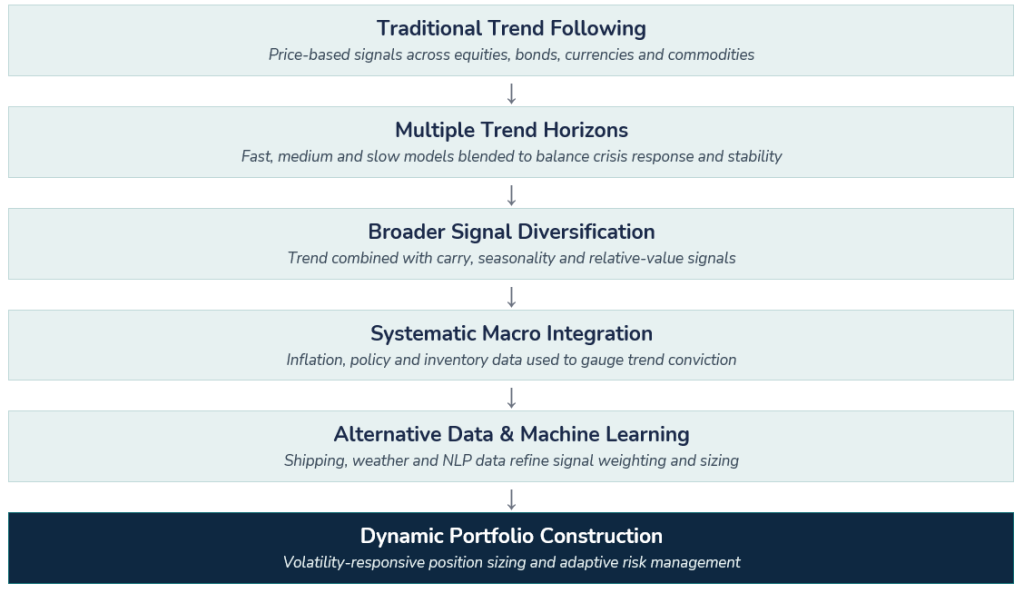
Exhibit 1: The evolution of trend-following implementation
Five themes shaping the next generation of trend following
- Speed matters more than ever. Faster models react quickly to sharp reversals but trade more and can be whipsawed by noise; slower models are steadier but can lag turning points. Rather than picking a side, most managers are blending trend horizons or dynamically adjusting speed, a priority sharpened by 2025–26’s V-shaped reversals, including the April 2025 tariff shock and the March 2026 Iran conflict.
- Diversification now goes beyond adding markets. Alongside a wider futures universe including interest rate swaps, equity factors, power markets and Chinese futures, managers are blending trend with non-trend signals (carry, seasonality, macro and relative-value) that can perform when price trends are flat.
- Price trends are being complemented, not replaced, by macro data. Several managers now describe themselves as systematic macro investors, layering inflation expectations, policy signals, inventories and shipping data on top of price signals to gauge trend conviction.
- Machine learning is refining implementation, not reinventing it. Managers are using it to size positions, forecast volatility and weight signals while keeping models explainable for institutional mandates.
- Portfolio construction is now a key differentiator. Dynamic position sizing and volatility-responsive risk management were raised by every manager as central to resilience through sudden reversals.
Exhibit 2: What each theme means for investors
| Theme | Investor benefit |
| Dynamic trend speeds | Improved response to changing markets |
| Broader diversification | Reduced reliance on individual trends |
| Systematic macro signals | Additional return sources |
| Alternative data | Better understanding of market drivers |
| Dynamic risk management | Improved portfolio resilience |
Of the five themes above, speed has emerged as the most active area of research. Rather than committing to a permanently faster or slower model, managers are increasingly exploring dynamic allocation between trend speeds – adjusting how quickly a portfolio reacts as market conditions change.
For instance, Manager C has been researching dynamic momentum speeds, seeking to increase sensitivity during stressed market environments while maintaining slower signals during more stable periods. Manager B has similarly explored dynamic signal weighting, allowing the portfolio to adjust exposure depending on signal strength and market conditions with machine-learning overlay. Whereas, Manager D has maintained a balance of faster and slower trends, recognising the trade-off between crisis responsiveness and long-term efficiency.
The broader industry direction is therefore moving towards adaptive portfolio construction, where the speed of the strategy itself becomes a source of diversification.
Exhibit 3: Manager research focus
| Research focus | A | B | C | D | E |
| Dynamic trend speed | ✓ | ✓ | ✓✓ | ✓ | ✓ |
| Portfolio construction | ✓ | ✓✓ | ✓✓ | ✓ | ✓✓ |
| Machine learning | ✓ | ✓✓ | ✓ | △ | ✓ |
| Alternative data | ✓ | ✓✓ | ✓ | ✓ | ✓ |
| New markets | ✓✓ | ✓ | ✓✓ | ✓ | ✓ |
| Execution optimisation | ✓ | ✓ | ✓✓ | ✓ | ✓✓ |
What this means for advisers
Despite different investment approaches, leading managers are increasingly focused on similar areas: improving diversification, adapting signal speed and enhancing portfolio construction.
The investment philosophy behind managed futures hasn’t changed, but implementation has become considerably more sophisticated, blurring the line between trend following and broader systematic macro investing. For advisers, this shifts the key question when comparing managers: it is less about whether a manager follows trends, and increasingly about how well they execute on speed, diversification, data and risk management. Those implementation differences, not the shared label, are likely to be the main driver of return dispersion between managers from here.
Source: Lonsec manager review meetings with rated universe of five managers across the 2026 Alternatives review cycle. Manager research-focus ratings and priority rankings are illustrative, based on qualitative discussions rather than a formal survey. This document is general information only and does not constitute personal financial advice.
Important Information: This article has been produced by Lonsec Research Pty Ltd ABN 11 151 658 561, AFSL No. 421445 (Lonsec). Generation Development Group Limited ABN 90 087 334 370 is the parent company of Lonsec Research.
Warning: The content presented in this article is for informational purposes only and is not a prospectus, product disclosure statement or any other form of disclosure document within the meaning of the Corporations Act 2001. Any express or implied rating or advice presented in this article is limited to “general advice” (as defined in the Corporations Act 2001 (Cth)), without taking into account the investors’ objectives, financial situation and needs. Prior to acting upon any information presented in this article, advisers must do their own investigation and analysis of the appropriateness of the information for their investor, having regard to their objectives, financial situation and needs.
Disclaimer: Lonsec Research have provided this article for exclusive use of its clients. It is not intended for use by a retail client or member of the public and should not be used or relied upon by any other person. No representation, warranty or undertaking is given or made in relation to the accuracy or completeness of the information presented in this article. Lonsec Research assumes no obligation to update this article following publication. Except for any liability which cannot be excluded, Lonsec Research, their directors, officers, employees and agents disclaim all liability for any error or inaccuracy in, misstatement or omission from, this article or any loss or damage suffered by the viewer or any other person as a consequence of relying upon it.